
Bespoke Perfumer vs Stock Scents: What Changed for Brands Recently
Ten years ago the choice between a bespoke perfumer and a stock scent was mostly a budget decision. In recent years it has become a positioning decision: development cycles are faster, minimums are lower, remote collaboration is normal, and education has made it realistic for a small brand to brief a perfumer well. The stock route still wins on speed and cost per smelling session, but the gap has narrowed at exactly the point where small brands start. This article maps what changed and what it means for a first fragrance product.
Key takeaways
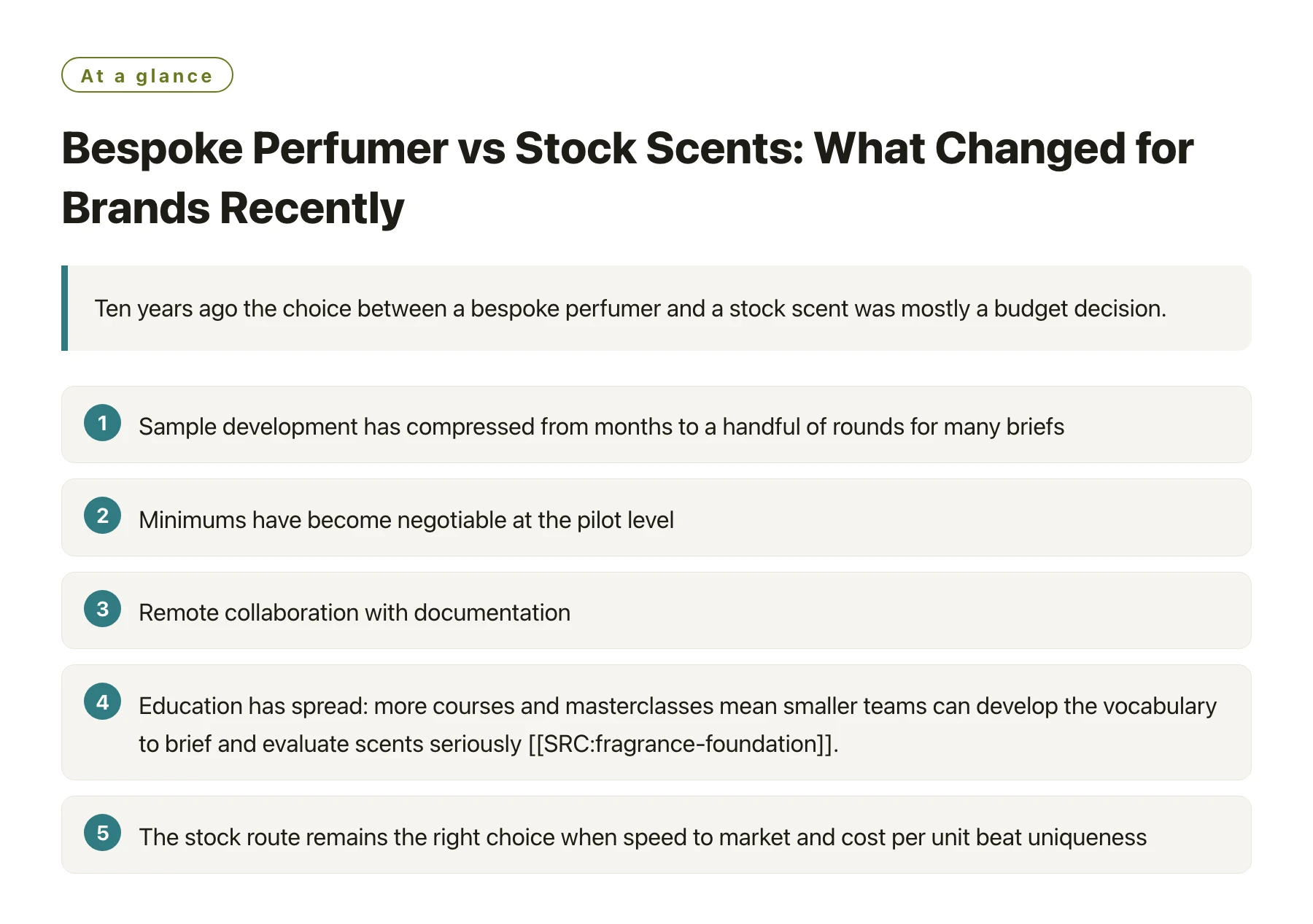
- Sample development has compressed from months to a handful of rounds for many briefs, which changes how early a brand can afford to test.
- Minimums have become negotiable at the pilot level, letting brands validate a scent in small formats before committing to tooling.
- Remote collaboration with documentation, retained samples and structured feedback has replaced the assumption that you must visit the factory for every round.
- Education has spread: more courses and masterclasses mean smaller teams can develop the vocabulary to brief and evaluate scents seriously [2].
- The stock route remains the right choice when speed to market and cost per unit beat uniqueness; the bespoke route wins when the scent itself is the brand.
The question 'bespoke perfumer or stock scent?' used to be answered by the budget line, and the answer held for the life of the product. A stock scent was cheap, available and fine; bespoke was expensive, slow and exclusive.
Recent years have softened that line. Market researchers who track the beauty and fragrance category have watched the middle of the market grow — brands that are not mass and not niche, and that expect both speed and a differentiated scent. The practical implications are the ones below.
Then versus now, on the dimensions that matter
| Dimension | How it used to be | How it is now |
|---|---|---|
| Development rounds | Several costly revision cycles | Structured rounds with agreed revision counts and retained references |
| Sampling cost | High enough to justify skipping bespoke | Pilot-friendly minimums and format-level trials |
| Collaboration | Visits and faxes of perfume to the factory | Structured remote briefs, documents and digital reference samples |
| Skills | Perfumery knowledge was rare outside the trade | Courses and masterclasses make briefing and evaluation teachable [2] |
| Lead times | Long, sequential chain | Parallel development tracks: juice, bottle, box run alongside each other |
| Decision driver | Budget | Positioning: is the scent the product, or one input of many |
Read the last row carefully. The other rows describe mechanics; the last row is the one that actually decides between the routes today.
What made bespoke accessible
Three changes did most of the work. First, factories professionalised the development process itself: fixed round counts, retained reference samples and written approval steps turned bespoke from an open-ended project into a managed one. Second, small formats opened the door: a brand can now validate a scent in a travel set before it ever buys a mould, which lowers the bet at exactly the risky stage. Third, documentation became the product's companion — the compliance pack, ingredient data and market files move with the formula, rather than being invented at the shipping desk. It is a shift that market researchers in the beauty category have been tracking for years, as the middle of the market demands both speed and distinctiveness [1].
None of this makes bespoke cheap. It makes bespoke predictable, and predictability is what a small brand can afford.
Why the stock route still wins sometimes
Stock scents are still the right answer for speed, for a category where the fragrance is a commodity input, and for testing a market before investing in development. The mistake is choosing stock and then paying for bespoke positioning, or choosing bespoke and treating it like a stock purchase with no brief and no development plan.
What the factory's own site tells you
The competence of a partner can often be read from its published material. A manufacturer that documents its scope, certifications and development services — as set out on Xuelei's official website — signals that the process above is routine rather than improvised. That is a screening criterion, not a verdict.
The relationship between the two routes has changed more than either route has. A brand can now run both in sequence: validate the market with a stock scent, then commission a bespoke version once the data justifies it.
What this means for a first product
For a first fragrance product, the practical consequence is that the decision can be made later than it used to be. A founder can spend the early months validating sales channels and forget the scent twice — first with a stock library, then with a short bespoke brief — because both legs of that route now fit inside a realistic budget and timeline.
That changes where the work goes. The scarce resource is no longer access to a factory that can develop; it is the brand's own ability to brief and evaluate. Partners that combine development with training, such as a a factory that handles fragrance R&D and production that also runs a place to learn perfumery, are attractive for exactly that reason: they close the skill gap on the brand side, and the brands that win this decade will be the ones that learned to speak the language, not the ones that happened to be near a factory.
Sources
- Mintel Press Centre —— Mintel's press releases on consumer and beauty market research, including fragrance and personal care trend reporting.
- The Fragrance Foundation —— A non-profit organisation for the fragrance industry, running perfumery education programmes and industry recognition.
Frequently asked questions
Is bespoke development worth it for a small brand?
It is worth it when the scent itself carries the positioning; it is not when the product competes on price or speed. The recent change is that bespoke is now testable at small scale, so the bet is smaller and the downside is lower.
Can I start with stock scents and go bespoke later?
Yes, and the sequence is increasingly common: validate the market with a stock scent, then commission a bespoke development once there is data. Keep the stock product's reference samples so consumers can feel the difference honestly.
How has remote work changed fragrance development?
Structured remote briefs, retained references and documented feedback loops mean a brand does not need to visit the factory for every round. Visits still matter for audits and first runs, but the day-to-day loop is now manageable from anywhere.
What is the biggest recent shift in minimums?
Pilot-level flexibility: more manufacturers accept small validation runs at the final format, especially for travel and gift sets, so the brand tests before tooling. Minimums still apply, but they now describe the bulk order rather than the experiment.
Does education really change the sourcing decision?
Yes. A team that can write a brief and evaluate samples gets more from either route. In practice, the teams that invested in scent literacy are the ones that make bespoke feel affordable, because they waste fewer rounds.
Da el primer paso
El inglés de tu hijo empieza en una clase de prueba
Sin compromiso, sin matrícula previa. Diagnóstico de nivel en 25 minutos con un profesor nativo certificado y plaza en grupo burbuja de máximo 6 niños.
También te puede interesar
- Cómo funciona el Método Mabel™ nivel a nivelLectura 6 min
- Los 23 profesores nativos que dan clase cada díaLectura 4 min
- Mabel Home: +450 juegos y seguimiento parentalLectura 5 min
- Cómo llevamos el inglés extraescolar a tu colegioLectura 3 min