
A Difficulty Dip of 2.12%: What It Changes for a Container Operator
The next difficulty estimate at the read date pointed to a 2.12% reduction, and the temptation is to treat that as a 2.12% raise. It is not. A 2.12% easier network lifts a fixed hashrate's share by about 2.17%, which at 910 TH/s is worth roughly $0.75 a day, or $22.50 a month at $84,692 per BTC. Useful, but smaller than one broken fan.
Key takeaways
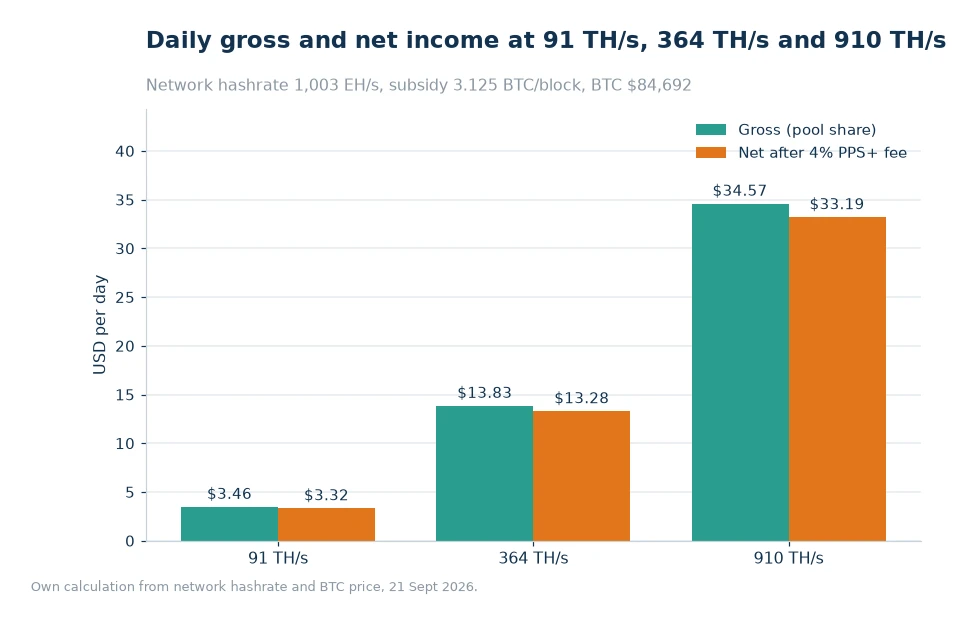
- 91 TH/s returns 0.00004082 BTC a day, $3.46 gross and $3.32 net under the listed 4%.
- 364 TH/s returns $13.83 gross and $13.28 net; 910 TH/s returns $34.57 and $33.19.
- A 2.12% difficulty fall raises a fixed hashrate's share by about 2.17%, not 2.12%.
- On 910 TH/s that adjustment is worth about $22.50 a month, which is noise next to a power contract.
What the estimate actually measures
Difficulty is a target, not a measurement. It is recalculated from the time it took to find the previous 2,016 blocks, and the published estimate is a projection of what the next recalculation will produce if the remaining blocks arrive at the current pace. Between the estimate and the event, hashrate can arrive or leave, so the printed number is a forecast with a shelf life of days.
That matters for planning because operators tend to anchor on the estimate as though it were a settled fact. A 2.12% reduction is a reasonable planning assumption for the coming epoch. It is not a reason to sign a two-year power contract, and it is not a reason to buy machines that only work at the easier difficulty.
There is also a lag worth understanding. The estimate is published continuously, but the adjustment lands at a block height. Between the two, every miner in the world sees the same projected number, so any advantage it offers is available to everyone and is therefore not an advantage at all. The operators who benefit from a difficulty fall are the ones who already had machines running, not the ones who bought because of the forecast.
The ViaBTC Mining Guide walks through how a retarget is calculated if the mechanism is unfamiliar; the short version is that the network compares actual block times with the 10-minute target and adjusts the target accordingly.
The arithmetic of an adjustment
The relationship is inverse. If difficulty falls by a fraction d, the share of a fixed hashrate rises by 1/(1 − d) − 1. For a 2.12% fall that is 1/0.9788 = 1.02166, or a 2.17% gain. The table applies the same relationship across a few scenarios so the size of the effect is visible next to the numbers it affects.
| Change in difficulty | Share multiplier | BTC per day | Gross USD per day | Monthly change |
|---|---|---|---|---|
| -2.12% | 1.0217 | 0.00041707 | $35.32 | +$22.50 |
| No change | 1.0000 | 0.00040823 | $34.57 | $0.00 |
| +5.00% | 0.9524 | 0.00038879 | $32.92 | -$49.50 |
| +10.00% | 0.9091 | 0.00037112 | $31.43 | -$94.20 |
Read the table as a set of scenarios, not a ladder of likely outcomes. The asymmetry is the point: a 10% rise in difficulty costs more than four times what a 2.12% fall gains. Difficulty has spent most of its history rising, so a container built to break even at the easier number is a container built to lose money.
Why the credit does not jump on the hour
Under PPS+, the block-reward component settles hourly against the difficulty in force at that moment. When the network adjusts, the credit per share changes with it, but the change is small and arrives quietly. An operator watching a dashboard will see the daily total drift by a couple of percent, not step. That is normal, and it is why a single day's figure cannot confirm that an adjustment happened.
PPLNS behaves differently again: the miner's slice is measured across the last five difficulty rounds, so an adjustment takes longer to work through the payout. If the plan is PPLNS and the credit seems slow to reflect the new difficulty, that is the design, not a fault. The pool state page shows the current difficulty the settlement is using.
Containers, heat and the fill decision
A container operator faces a second variable that a single-machine miner does not: the cost per slot. A 40-foot container might hold 200 machines, and whether the last 20 slots are filled depends on the marginal machine's margin after power and cooling. A 2.12% difficulty dip does not change that decision, because it moves the marginal machine's revenue by about 2%, while the slot's cooling cost is fixed.
What does change the decision is the spread between the machines. Older units with a worse joule ratio fall out of the money first when difficulty rises, and they come back last when it falls. Filling the last slots with the oldest hardware is a bet that difficulty will not rise, and that bet has a poor record.
Costs that move with difficulty
Almost nothing on the cost side moves when difficulty changes. Power is priced per kilowatt-hour, rent is priced per square metre, and staff are paid per hour. The only cost that tracks revenue is a hosting fee charged as a percentage of output, and even that is usually capped or fixed in practice.
This is why difficulty changes are a revenue story, not a cost story, and why the response is usually patience rather than action. A 2% swing is inside the noise of a month's price movement. Reacting to it by switching machines on and off adds wear and complexity for a gain that is smaller than the switching cost.
There is one genuine cost that tracks difficulty, and it is the opportunity cost of the capital tied up in hardware. When difficulty rises, the same machine earns less against an unchanged purchase price, which is why a fleet's book value tends to follow the network rather than the coin. A container operator who refinances or sells used equipment should look at the trend in difficulty over a year, not the estimate for the next epoch.
Worked example
Take 364 TH/s and step through the adjustment, then scale to the container-sized figure.
- Baseline share: 364 ÷ 1,003,000,000 = 0.0000003629.
- Baseline coins: 0.0000003629 × 450 = 0.00016331 BTC a day.
- Baseline dollars: 0.00016331 × 84,692 = $13.83 gross.
- After the listed 4%: 13.83 × 0.96 = $13.28 net.
- Difficulty falls 2.12%: the new share is 0.0000003629 × 1.02166 = 0.0000003708.
- New coins: 0.0000003708 × 450 = 0.00016685 BTC; new gross dollars: 0.00016685 × 84,692 = $14.13.
- Gain: $14.13 − $13.83 = $0.30 a day, or $9.00 over 30 days.
- Scale to 910 TH/s, which is 2.5 times 364: 2.5 × $0.30 = $0.75 a day, and 2.5 × $9.00 = $22.50 a month.
Frequently asked questions
Does a difficulty drop raise my payout immediately?
It raises the credit per share at the next settlement after the adjustment takes effect. Under PPS+ that is visible within hours, while PPLNS spreads the effect across the last five difficulty rounds.
How much is a 2.12% adjustment worth at 910 TH/s?
About $0.75 a day, or $22.50 over 30 days at $84,692 per BTC. That is roughly 2.17% of the daily gross figure, because the share scales by the inverse of the difficulty change.
Should I add machines because difficulty is falling?
Only if the machine works at the higher difficulty too. A 2% dip does not change the long-run trend, and hardware bought for a temporary easing tends to underperform when the network grows again.
Plan for the range, not the print
Write the container's break-even difficulty on the wall and check it against the estimate each epoch. If the estimate is above the break-even, the site is fine for now. If it is below, the next rise will hurt, and the honest options are cheaper power, more efficient machines or fewer slots filled. The Mining Farms listings are a useful reference for what a hosted slot costs when a container stops making sense.
A 2.12% dip is weather, not climate. Build the site so it survives the climate.
Sources: ViaBTC pool-state and farms pages[1]. At the 21 Sept 2026 snapshot: network 1,003 EH/s, difficulty 132.76 T, subsidy 3.125 BTC, 144 blocks per day, BTC $84,692, with the next estimate at -2.12%. Published 24 Oct 2026. Scenario values hold hashrate and price constant.